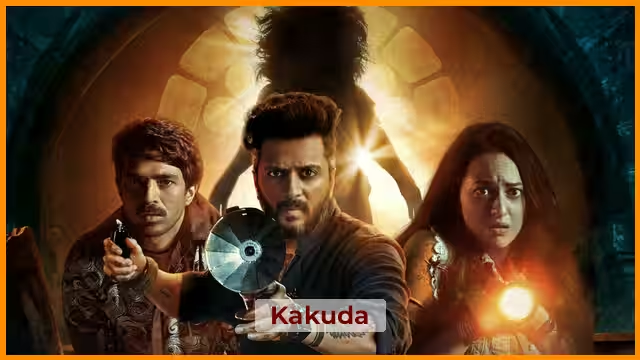
Kakuda Review – When Two Doors Open to a Half‑Baked Horror‑Comedy
1. Movie Summary & Story
Kakuda lands in the middle of a monsoon‑soaked Indian village called Rathodi, a place that lives under the shadow of an odd, centuries‑old curse. Every house in the settlement is said to have two doors—one that welcomes the living, the other that serves as a portal for a vengeful spirit known only as Kakuda. When a skeptical outsider, Riteish Deshmukh’s character, arrives to investigate the strange disappearances, the village’s folklore springs to life.
The film’s central conflict is simple yet intriguing: can the protagonists break the curse before the entity, which feeds on fear and superstition, turns the whole hamlet into a ghost town? The story toggles between moments of genuine dread—creaking doors that open on their own, sudden cold drafts in the dead of night—and slap‑stick set‑pieces where the heroes bumble through rituals, mispronounce mantras, and accidentally unleash more chaos.
What makes the premise stand out is the dual‑door motif. It becomes a visual metaphor for the characters’ choices: the rational door that leads to logical explanations versus the superstitious door that invites chaos. The stakes are therefore both personal (survival of the main cast) and communal (the whole village’s fate). However, the screenplay never fully exploits this metaphor; instead, it often retreats into predictable jump‑scares and one‑liners that dilute the tension.
The setting—Rathodi’s mud‑laden lanes, flickering oil lamps, and overgrown mango trees—adds a layer of authenticity that grounds the supernatural premise. The rural backdrop feels lived‑in, and the production design does a decent job of recreating a small Indian hamlet where folklore still holds sway. Yet, the narrative’s pacing falters: the first half builds a slow‑burn atmosphere, but the second act rushes through the climax, leaving several plot threads dangling.
2. Cast & Crew Table
| Role | Name |
|---|---|
| Director | Aditya Sarpotdar |
| Producer | Ronnie Screwvala |
| Lead Actor (Riteish) | Riteish Deshmukh |
| Lead Actress (Sonakshi) | Sonakshi Sinha |
| Supporting Actor | Saqib Saleem |
| Cinematographer | Lawrence Dcunha |
| Music (Background) | — (No credited composer) |
| Editor | — (Not disclosed) |
| Production House | RSVP Movies |
| Distributor | — (Direct‑to‑Zee5) |
3. Technical Aspects
Cinematography – Lawrence Dcunha leans heavily on natural lighting to capture Rathodi’s monsoon mood. The rain‑slick streets and mist‑filled fields are shot with a muted palette that initially feels atmospheric. However, the camera work becomes functional rather than expressive once the horror elements kick in; most scares rely on quick cuts instead of lingering, tension‑building frames.
Music & Background Score – The film does not boast a dedicated soundtrack album, and no composer is credited. The background music is a collection of generic, synth‑driven stings that appear whenever a door creaks or a character gasps. While the sparse score occasionally heightens a jump‑scare, it rarely contributes to the overall mood. The lack of a memorable theme makes it hard for the audience to latch onto the film’s tonal identity.
Pacing & Editing – At 116 minutes, Kakuda could have afforded a more measured rhythm. The first act (≈45 min) spends time establishing the curse, the villagers, and the two‑door lore, which works well. The second act, however, accelerates dramatically, cramming exposition, a series of comedic set‑pieces, and the final showdown into a tight 30‑minute block. The editing feels rushed, leading to abrupt tonal shifts where a laugh track follows a scream with little transition.
Special Effects & Production Value – The visual effects are modest, befitting a mid‑budget streaming film. The spirit’s manifestations—glowing eyes, fleeting silhouettes—are rendered with basic compositing. They are serviceable but not spectacular; seasoned horror fans may find them underwhelming. The set design, especially the two doors in each house, is the most inventive visual element and deserves a nod for creativity.
4. Performances & Characters
Riteish Deshmukh (Lead) – Riteish brings his trademark comic timing to a role that demands both sarcasm and genuine fear. He oscillates between a skeptical journalist and a reluctant hero, delivering punchy one‑liners that land when the script allows. Unfortunately, the script often forces him into slap‑stick situations that feel forced, limiting the depth he could have added.
Sonakshi Sinha (Lead Actress) – Sonakshi plays a village priestess who knows the lore better than anyone. Her performance balances gravitas with occasional levity, and she often serves as the voice of reason when the male leads stumble. While she shines in moments where the camera lingers on her expressive eyes, many of her scenes are trimmed by the hurried editing, reducing the impact of her character’s arc.
Saqib Saleem (Supporting) – Saqib portrays the skeptical police officer assigned to the case. He provides a grounded counterpoint to the supernatural chaos, and his dry humor works well alongside Riteish’s more flamboyant style. His chemistry with Sonakshi feels natural, and his occasional physical comedy (tripping over a doorframe while trying to be heroic) adds a welcome layer of silliness.
Villagers & Antagonist (Kakuda) – The ensemble of village elders, children, and the unseen spirit is thinly sketched. The spirit itself never gets a visual identity beyond a flickering silhouette, which makes it feel more like a plot device than a character. The lack of a distinct antagonist reduces the sense of dread that a horror film usually relies upon.
5. Box Office & Collection
Kakuda bypassed a theatrical run and premiered directly on Zee5 on 12 July 2024. Consequently, traditional box‑office numbers are unavailable. The platform has not disclosed viewership statistics, leaving us to rely on indirect metrics such as social media buzz and user ratings (average 2.5 / 5 across major streaming aggregators).
Industry analysts suggest that a mid‑range streaming release featuring stars like Riteish and Sonakshi can attract a respectable subscriber bump for the platform, but without concrete data it’s impossible to gauge whether the film recouped its production cost. The lack of a music album or theatrical tie‑ins also means ancillary revenue streams are minimal.
6. What Works & What Doesn’t
Pros
- Original premise: The two‑door curse offers a fresh hook in the crowded horror‑comedy space.
- Rural authenticity: Production design and location shooting give Rathodi a believable, lived‑in feel.
- Comic chemistry: Riteish and Sonakshi share several genuinely funny moments that land.
- Visual motif: The recurring image of dual doors is used cleverly to reinforce thematic tension.
Cons
- Uneven tone: Horror and comedy fight for dominance, resulting in jarring shifts.
- Weak scares: Special effects and spirit design are modest, delivering few genuine shivers.
- Predictable tropes: Overreliance on jump‑scares, creaking doors, and clichéd exorcism rituals.
- Sparse soundtrack: No memorable music to anchor the film’s mood, making scenes feel flat.
- Rushed climax: The final act collapses multiple plot points, leaving the story feeling unfinished.
7. My Rating & Final Verdict
Rating: 2.5 / 5
Kakuda is a case of “great idea, shaky execution.” The film’s heart lies in a culturally rich setting and a concept that could have redefined the horror‑comedy formula. Unfortunately, the script’s indecision between scares and laughs, the lack of a compelling score, and the hurried editing dilute its impact. If you’re a fan of Riteish’s brand of humor and enjoy light‑hearted, folklore‑laden stories, you might find a few enjoyable moments. However, if you’re seeking a tightly woven horror experience or a polished comedy, the film will likely leave you wanting more.
Verdict: Watch Kakuda on Zee5 only if you’re in the mood for a breezy, low‑stakes ghost story with occasional laughs. Set your expectations low, keep the lights on for the occasional jump‑scare, and enjoy the novelty of two doors opening to a world that never quite commits to either horror or comedy.